
Infrastructure Solutions
- Liners
Liners
Americore International is one of the representatives for Channeline Products in the USA. Channeline is an approved product by the City of Los Angeles as well as several other agencies.
Introduction
Large diameter pipelines and culverts represent the backbone of any city’s utility network for the collection and disposal of sewerage and effective drainage of storm-water.
In many cases the fabric of these pipelines, which may consist of brick, stone, concrete or clayware will have been constructed decades ago and although proven resilient, has eventually succumbed to the ravages of time, suffering the effects of H2S attack or erosion and may even be exhibiting signs of imminent failure due to structural loading beyond that of it’s remaining capability.
At this point the need arises to consider the means by which the structural rehabilitation of these pipelines and ducts can be achieved whereby a new, 50-year plus life expectancy can be provided with a high degree of confidence.
Channeline has been involved in the provision of specialist GRP structural lining elements for just this requirement for over 25 years during which time we have accumulated an unrivaled degree of experience relative to the rehabilitation of both circular and non-circular large diameter buried pipeline structures worldwide.
We have grown to be a global business based on the integrity and performance of the product we design and manufacture. We are proud of our heritage and committed to serve our existing and future customers in the water and wastewater industries.
History
Channeline truly does have its roots firmly in the history of investigation, design and engineering of structural liner solutions for the large diameter pipeline industry.
Originally formed in the 1970’s as a design consultancy company, specifically to offer services for pipeline corrosion and structural studies for the chemical, pharmaceutical and water industries, they were working on potential solutions to problems relative to structural and corrosion failures in large diameter sewers for major water companies in Europe, as far back as 1978.
In 1979, the U.K. government commissioned the Water Research Council (WRc) to undertake a US$ 20 million intensive research program on materials and methods of design for the structural rehabilitation of sewers and Channeline was heavily involved in this research with the WRc. It was from this research that stemmed the original concept of structural segmental and one-piece lining systems for man entry sewers and pipelines.
This early work included painstaking analysis of matters such as:
- Finite element studies and computer modeling
- Mechanical testing
- Wet abrasion testing
- Flow monitoring
- Corrosion resistance evaluation
- Strain corrosion testing
In 1984, this investigative study resulted in the publication of the first edition of the WRc Sewerage Rehabilitation Design Manual and in the same year, Channeline produced the first commercially available “STRUCTURAL MAN-ENTRY” lining system in GRP.
During the ensuing three decades a huge amount of practical experience has been obtained enabling Channeline to further refine resin and reinforcement elements used in the product manufacture, with continuous improvements in jointing and grouting techniques.
Working closely with both end users and contractors we have now evolved what we sincerely believe to be the best GRP structural large diameter pipe rehabilitation product and methodology available on the market today.
Product
The general concept of the Channeline product is that a remarkably stiff and strong panel section is constructed, but with a relatively thin wall.
The product differs from that of standard GRP hand or filament wound pipework in several fundamental and important ways. Normal GRP pipework consists of windings of layers of resin-saturated glass, achieving its stiffness by building up ever-increasing wall thickness. Channeline however, derives its strength and stiffness through a different method, employing the mechanics of core, or sandwich panel design.
The first stage of Channeline manufacture is an inner sandwich structure incorporating a 1.5 mm corrosion barrier on the inside surface which is manufactured from high grade surface veil precisely impregnated with Isophthalic or Vinyl- Ester resin, followed by several layers of thoroughly impregnated multi-axial engineered fabric and CSM, forming the inner sandwich skin.
Next, comes a central core, comprising of carefully metered amounts of silica and resin which is pre-batched, mixed, and evenly applied to the exact thickness required.
The outer sandwich skin is then formed using several further layers of multi-axial fabric, CSM and resin, with the outer surface being treated with a bonded graded aggregate to enhance adhesion to the annular grout, which is used during the installation phase.
The sandwich construction process is continuous, and carefully monitored and controlled ensuring exceptional bonding of all layers throughout the process.
ss is continuous, and carefully monitored and controlled ensuring exceptional bonding of all layers throughout the process.
Shapes and Sizes
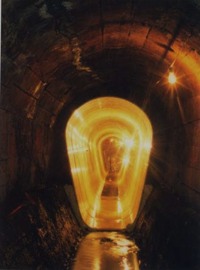
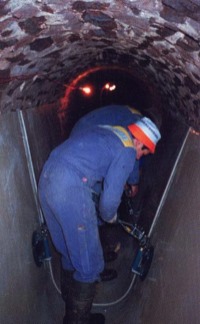
There really is no theoretical limit to the shape and size of Channeline panel that can be effectively manufactured. Because Channeline technology includes the evolution of multi-piece segmental construction, where necessary for transportation, even very large, peculiar shaped rehabilitation projects can be accommodated using Channeline product.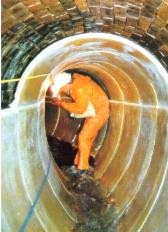
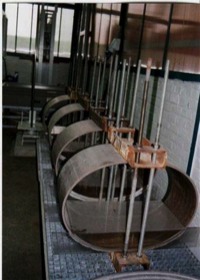
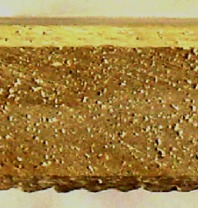
Cross section of sandwich panel construction
- Manholes
Manholes
Standard FRP Manholes
24”/36”/42”/48”/54”/60”/72”
ASTM D3753
Experience...
LFM has been building quality fiberglass reinforced manholes, manhole liners, wetwells and wetwell liners since 1982. We utilize the latest in chop and filament winding equipment, therefore providing our customers with the highest quality fiberglass products on the market today
Economical...
LFM fiberglass manholes are light-weight, greatly reducing delivery and installation costs.
Due to the anticorrosive nature of LFM's fiberglass manholes, corrosion-related repair and replacement costs are reduced as well.
Professional Delivery...
LFM maintains its own fleet of delivery trucks, helping to lower delivery costs considerably.
LFM fiberglass manholes are light-weight and can be shipped via common carrier freight lines anywhere in the continental U.S.
Strong & Lasting Construction...
Fiberglass manholes by LFM are designed and manufactured to meet or exceed all ASTM D3753 Standard specifications.
In addition, to complying with all ASTM Standards, LFM fiberglass manholes carry an H20 load rating. LFM products are engineered to provide the client with long and trouble-free service.
Quality Assurance...
LFM stands behind their products. LFM fiberglass manholes carry a limited one year warranty.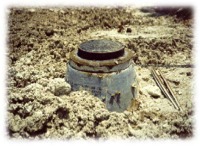
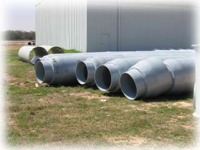
- Couplings and Spacers
Couplings and Spacers
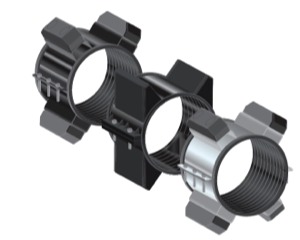 Carbon Steel & Stainless Steel Spacers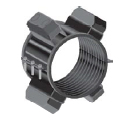
• Heavy duty two-piece #304 Stainless Steel or Carbon Steel Spacers with durable glass filled polymer runners.
• Available in 8 inch and 12 inch widths. (8'' width through 36'' pipe recommended)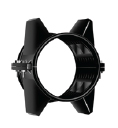
• Fast and easy installation on concrete, PVC, ductile iron, polyethylene, and steel cased crossing applications.
• Spacers are lined with ribbed EPDM to prevent electrical contact between the carrier pipe and the metallic spacer.
• Carbon Steel Spacers are fabricated from pickled and oiled steel and then coated with a fusion bonded copolymer based thermoplastic for superior abrasion resistance and corrosion protection.
• Spacers for bell & spigot joints, or large diameter applications, are designed and fabricated to insure an extra margin of support.
• CCI Pipeline Systems has the experience to design and manufacture virtually any configuration of casing
spacer, including multi-carrier clusters within a single casing.Polyethylene Spacers
• Injection molded from high-density polyethylene.
• Provide an economical alternative to metallic casing spacers.
• Excellent dielectric strength and low moisture absorption provide minimal electric current loss with no impairment of cathodic protection.
• High impact resistance and excellent frictional characteristics make polyethylene spacers a pipeline industry standard on mechanical joints, restrained joints, push-on joints and welded pipe joints.
End Seals
Model ESW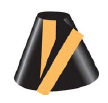
• Wrap-around neoprene rubber end seal.
• Designed for field installations where the carrier pipe has been installed in a casing.
• Involves simply wrapping the seal around the carrier pipe and casing; then compressing the adhesive strips to form a seal.
• Installation is completed when the stainless steel banding is installed and tightened.
Model ESC
• Seamless neoprene end seal.
• Easily installed as the carrier pipe is pulled through the casing. The installation process is completed with the installation of stainless steel banding straps to the carrier and the casing pipe.
• This end seal has excellent chemical resistance and retains good flexibility.
Model CSK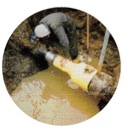
• High expansion heat-shrinkable kit with support skirting.
• Manufactured with a unique “Snap-Fit” closure system and a temperature indicating pigment that changes color upon reaching proper temperature.
• Installation is simple and guesswork is eliminated for the installer.

- http://www.langpierceclient.com/americore/resources/bg1.jpg